

🇫🇷 Dispatch from France
Special Edition: NEONICOTINOIDS, Is France Deliberately Poisoning Its Own Bees?


Despite two million signatures, an unprecedented scientific mobilization, and a constitutional shield, the French Parliament refuses to stop trying to bring back the “bee killers.”
Dear Friends,
When Anonymous Media Group asked if I knew anything about the French government's decisions on a bee-killing pesticide, I had no idea I was about to go down this deep a rabbit hole.
It took some time for me to check and reference some sources to ensure that the information I delivered was not only accurate but also understandable.
That's why today's “Dispatch from France” will be a little different, as it's another SPECIAL EDITION presenting you with all of my findings.
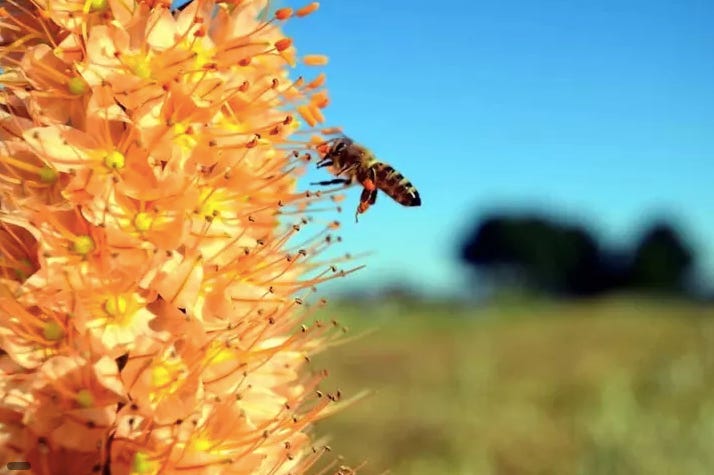
The Silence That Kills or When the Hives Go Quiet
There is no more unsettling sound in the French countryside than that of a hive falling silent. No explosion, no visible catastrophe, just a slow, almost gentle disappearance that nonetheless signals the collapse of one of nature’s most irreplaceable links in the chain of life.
French beekeepers have been hearing that silence for years.
The French National Beekeeping Union (UNAF) has put hard numbers to the scale of the disaster: since neonicotinoid pesticides entered the market, roughly 300,000 hives die in France every year, that’s a 25% increase in colony mortality. [Source: GDSA Dordogne].
These synthetic insecticides:
acetamiprid,
flupyradifurone, and
sulfoxaflor
function as systemic neurotoxins. They scramble the nervous systems of insects, disorient foraging bees, prevent them from finding their way home, and ultimately wipe out entire colonies. Not in one blow, but slowly, soundlessly, like a creeping dementia [Source: Fondation pour la Nature et l’Homme (FNH), 2025].
Honeybees aren’t the only casualties.
Wild pollinators across the board: bumblebees, butterflies, and hoverflies, are in retreat. And with them, the very capacity of agriculture to sustain itself is under threat:
75% of the world’s food crops depend, at least in part, on animal pollination [Source: FAO].
France had grasped all of this.
In 2018, France even enacted this understanding into law.
2018: The Year France Said No to Poison
The EGALIM Act of 2018 was a rare legislative victory: for the first time, French lawmakers had the backbone to ban neonicotinoids outright—including as seed coatings—in the face of enormous pressure from pesticide manufacturers and significant parts of the agricultural sector. One of the strictest bans in Europe, it put France at the forefront of the international conversation on pesticide reform.
The same law built in another safeguard: the mandatory separation between pesticide sales and agricultural advisory services. Farmers could no longer receive “advice” from the very people selling them the chemicals. A cozy arrangement that had, for decades, let agrochemical lobbies keep a stranglehold over farming practices [Source: parliamentary report cited in Vert.eco, 2025].
For six years, the framework held.
Narrow exemptions were granted, notably to the sugar beet sector between 2020 and 2023, under strict conditions reviewed by the Constitutional Council.
But the ban itself stood. The bees, for once, could breathe.
Then came 2024. And with it, the rage of the fields.

Fury in the Fields, Calculation in the Halls of Power
The early months of 2024 saw tractors blockading French highways in one of the country’s most dramatic agricultural protests in decades. The underlying crisis was real, deep, and economically legitimate: collapsing farm incomes, crushing operating costs, unfair competition from European and international rivals, and environmental regulations that felt like yet another burden in a market that rewarded none of it.
In this climate of political emergency, certain lawmakers saw an opportunity.
Senator Laurent Duplomb (Republicans, Haute-Loire)—a product of the FNSEA and Young Farmers networks, France’s two dominant agricultural unions—introduced a bill described as “removing obstacles to the farming profession” [Source: Vert.eco, July 2025].
The framing was shrewd.
Who could be against lightening the load on struggling farmers?
But buried inside the language of simplification was a live grenade: the reauthorization by executive decree of acetamiprid, flupyradifurone, and sulfoxaflor, the very “bee killers” banned since 2018.
For three renewable years.
With no limits on which agricultural sectors could use them, no strict oversight framework, no sunset clause.
The bill also dismantled the advisory-sales separation enshrined in the EGALIM Act, which previously ensured that agricultural advice was independent from sales interests, potentially leading to conflicts of interest in agricultural practices.
When Senator Duplomb was asked point-blank whether acetamiprid was carcinogenic, he didn’t blink on ICI Pays d'Auvergne on Monday, February 9, 2026: “No serious study has ever demonstrated that this molecule causes cancer” [Source: FranceInfo.fr (10/02/2026)].
The People vs. Parliament: Two Million Voices, Ignored
What followed was without precedent in French democratic history.
Civil society—scientists, physicians, beekeepers, environmental organizations, and ordinary citizens—mobilized with a unity and force rarely seen.
A petition demanding the law’s repeal gathered more than 2.1 million signatures, making it the second most-signed petition in the history of the French Republic [Source: Greenpeace.fr]. Over 2,000 veterinarians and veterinary students co-signed an open letter to the Constitutional Council [Source: Vétérinaires pour la Biodiversité, July 2025]. Coalitions of physicians, pharmacists’ associations, and researchers from France’s CNRS and INRAE spoke out.
Protesters chained themselves to the gates of the National Assembly.
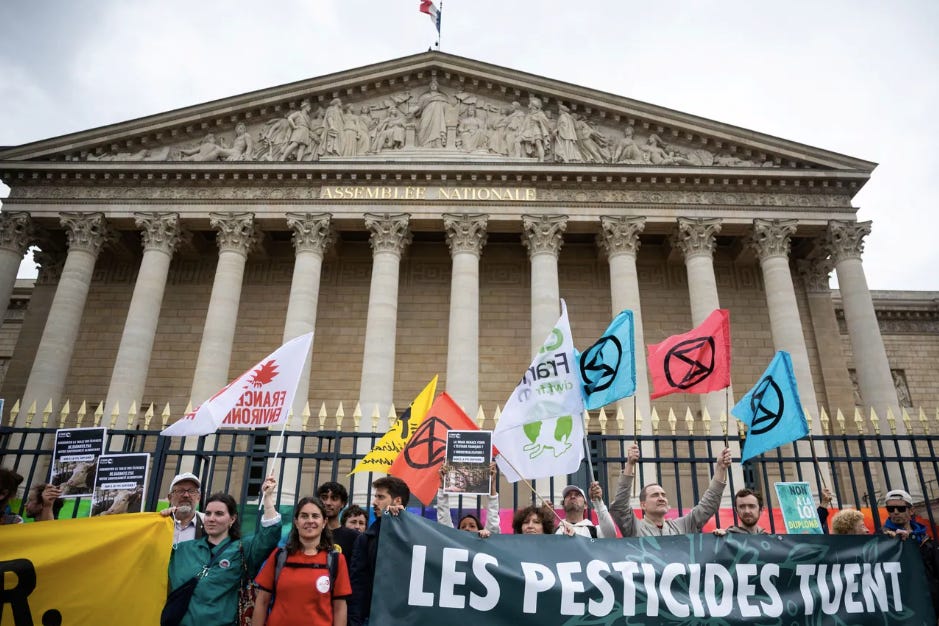
Parliament voted anyway.
The bill was definitively passed on July 8, 2025 by both the National Assembly and the Senate.
The left (Socialists, Greens, and France Insoumise) voted against it unanimously.
The right and part of the center carried it through.
The bulk of the right-wing and far-right bloc fell in line behind it [Source: La Gazette France, September 2025].
A Green Party MP put it without sugarcoating: if Senator Duplomb was pushing to bring neonicotinoids back, he was either “genuinely convinced that cancer is fine, or he’s completely in the pocket of the agro-industrial lobbies.” [Source: LCP, February 2026].
No rebuttal came.

The Constitutional Council: The Republic’s Last Line of Defense
One hope remained.
One final institutional lock: the Constitutional Council, immediately referred to by left-wing parliamentarians the moment the bill passed.
On August 7, 2025, the Council delivered its ruling.
On the most critical point, it was unambiguous: Article 2 of the Duplomb Law, which reintroduced neonicotinoids, was struck down because it was found to be incompatible with the Environmental Charter, which has been constitutional since 2005 [Source: LCP Assemblée nationale, August 2025].
The Council’s language was precise: pesticide products containing neonicotinoids, it stated, “affect biodiversity, impact the quality of water and soil, and pose risks to human health.” By allowing exemptions without adequate safeguards, Parliament had “stripped of legal protection the right to live in a balanced environment that is respectful of health.” [Source: Constitutional Council, decision of August 7, 2025].
Paragraph 79: “les produits en cause ont des incidences sur la biodiversité, en particulier pour les insectes pollinisateurs et les oiseaux, ainsi que des conséquences sur la qualité de l’eau et des sols et induisent des risques pour la santé humaine”
Paragraph 83: “le législateur [...] a privé de garanties légales le droit de vivre dans un environnement équilibré et respectueux de la santé garanti par l’article 1er de la Charte de l’environnement”
What ultimately sank the exemption was its sheer scope: it applied to all agricultural sectors, with no fixed time limit, for all types of use and treatment. That kind of blank check to the agrochemical industry went far beyond even the 2020 precedent—which had allowed a tightly framed, time-limited exemption for sugar beet farmers only—and the Council would not let it stand [Source: La Gazette France, September 2025].
The law was still signed by President Emmanuel Macron and published in the Journal Officiel on August 12, 2025, with its most harmful clause removed but its other provisions unchanged: easier permitting for mega-reservoirs, higher thresholds for intensive livestock operations, and the abolition of the advisory-sales separation [Source: La Gazette France, September 2025].
A half-victory. Relief mixed with bitterness.
The Undead Law: Act II
One might have hoped the lesson had been learned.
It had not.
The moment the Constitutional Council’s decision was published, Senator Duplomb announced he was drafting a new bill, this time tailored to satisfy constitutional requirements, that would reintroduce exemptions for the three banned pesticides.
This was a version 2.0, carefully reworked to evade the Council’s scrutiny.
Meanwhile, from the other side of the aisle, the left filed its own bill on September 16, 2025, one seeking to repeal the Duplomb Law definitively and make the neonicotinoid ban permanent while incorporating the latest scientific data and taking concrete action against unfair international pesticide competition [Source: National Assembly, 17th legislative session dossier].
On February 11, 2026, the National Assembly held a formal hearing on the citizen petition.
Two million voices in a chamber built for 577.
Meanwhile, the new version of the Duplomb Law was waiting in the wings.
The cycle had begun again.
Who Does French Agriculture Actually Serve?
Behind the technical debate over molecules and market sectors lurks a political and civilizational question that no one dares ask out loud:
Who is French agriculture actually for?
For farmers themselves—the men and women whose incomes are in free fall, whose bodies bear the long-term damage of chronic pesticide exposure, and who are, according to the very physicians and veterinarians who have studied their plight, the first victims of these substances.
For consumers—who eat these crops, drink this water, and breathe this air and whom the French League Against Cancer warns face worsening exposure to suspected carcinogens?
For bees and pollinators, without whom neither farmers nor consumers have food to speak of? Or,
For the manufacturers of acetamiprid, flupyradifurone, and sulfoxaflor, whose lobbyists know every corridor in the Senate building by heart?
The Duplomb Law, unfortunately, offers a partial answer.
Conclusion
There is something that looks like hope in this story.
The Constitutional Council held firm.
Two million people signed.
Veterinarians, doctors, and researchers formed an uncommonly united scientific front. For now, legally, the bees have not been handed over.
But the battle isn’t over.
It will never be definitively won as long as the underlying structure of agricultural power, dominated by the majority farm unions and the big agrochemical corporations, remains unreformed.
As long as farmers themselves aren’t protected from the pesticides sold to them as solutions, from the market prices imposed on them as inevitable, and from an agricultural policy that uses them as cover to justify environmental rollbacks that serve entirely different interests.
For now, the hives are still buzzing.
Fragile.
Threatened.
Holding on.
For how much longer?

IS IT PROPAGANDA?® —Read. Decide. Question everything.
 | A guest post by
|
 | A guest post by
|
We continue to poison our environment. Our neighbors are feeling the effects and soon will we.
Great job bud!