
🇫🇷 Dispatch from France
Week of March 23-29, 2026


Did you know you can ‘like’ and comment on this newsletter? Follow the link below to join my community on the Substack app and join the conversation about IS IT PROPAGANDA?® Not only is it FREE to use, but it’s also ad-free.
Dear Friends,
In collaboration with Anonymous Media Group and The Dirty Dozen Dispatch we are excited to continue our weekly series titled “Dispatch From France” written by Jerry B. Marchant of IS IT PROPAGANDA?®
This week and for the next four weeks, I am on La Croisette in Cannes, on the French Côte d'Azur. It could become a permanent relocation for me and our newsletter, IS IT PROPAGANDA?®, but you'll learn more as time goes on.
I will soon publish another SPECIAL EDITION of our "Dispatch from France" about the Russian diaspora of the past, including architects, diplomats, and artists buried at Le Cimetière du Grand-Jas.
But for today, let’s begin our weekly report with the Political Barometer
🇫🇷 🌡️ Weekly Political Barometer
March 2026 was marked by a particularly significant international sequence of events following the start of the conflict in Iran. In this specific context, Emmanuel Macron’s popularity rating rose slightly, bolstered by a visible shift in his stance on international issues and nuclear deterrence.
Having recently positioned himself on international issues and following his speech on French nuclear doctrine, Emmanuel Macron is in a relatively positive dynamic: 22% popularity (+2 points in one month).
This increase in popularity is particularly noticeable among environmentalists (22% favorable opinions, +7 points), Socialist Party supporters (25%, +10 points), and supporters of the centrist bloc (77%, +17 points). However, nearly three-quarters of the French still have a negative opinion of his performance as president (74%, -1 point).
The Prime Minister’s approval rating remained unchanged.
Prime Minister Sébastien Lecornu enjoys a fairly stable popularity rating: 25% favorable opinions (-1 point) and 61% unfavorable opinions.
Purchasing power remains the primary concern for the French (46% are worried about it, up 3 points in one month), followed by the future of the social welfare system (39%, up 1 point). Concern about international crises has surged this month (33%,
up 10 points) following the start of the war in Iran. In fourth place, concern about crime levels has fallen by 4 points (29%).
There should only be the French flag in a French town!
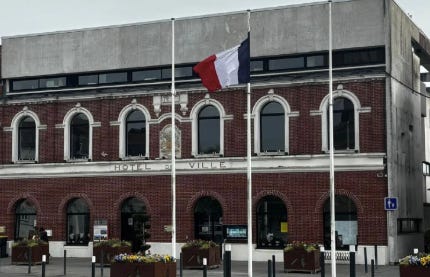
Following the municipalities elections throughout France, the new RN (Rassemblement National) mayor of Harnes (Pas-de-Calais) has removed the European and Ukrainian flags, leaving only the French flag on the town hall facade.
Anthony Garenaux-Glinkowski, 34, took office at the town hall, which had been controlled by the Socialist Party since 2008 and, before that, since 1944, led by Communist mayors.
The mayor of Harnes justified the removal of the European flag by stating that the town’s residents had voted “by an overwhelming majority” against the Treaty establishing a Constitution for Europe in the 2005 referendum.
French Public Deficit
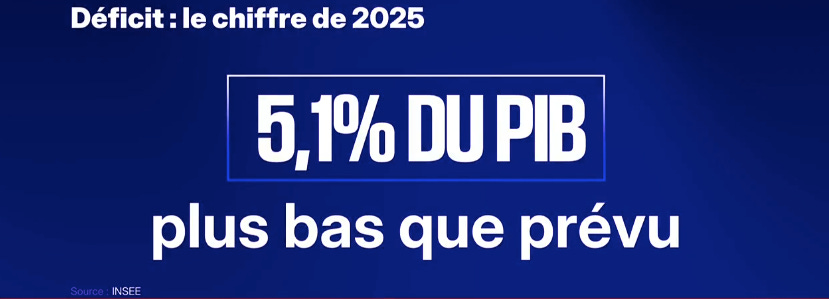
The figures for the French public deficit for 2025 have been released: it stands at 5.1% of GDP instead of 5.4%.
“the difference amounts to 10 billion euros.”
This figure puts all political leaders in a difficult position, as it proves that the government is perfectly capable of reducing fuel taxes.
How to solve fuel/gasoline problems
In Spain, the price of fuel fell to €1.51 per liter after VAT (Valued-added Tax) on fuel was halved, from 21% to 10%.
The price dropped from nearly €2 to €1.51 on March 22 as part of a €5 billion emergency plan adopted in response to the sharp price increases linked to the war in Iran.
This program also includes a reduction in taxes on electricity and gas, as well as a subsidy of 20 cents per liter for professionals.
Meanwhile, the French government refrained from further tax cuts to avoid a loss of revenue. A typical approach to solve problems.
Faced with rising global energy prices, Sébastien Lecornu’s government is mobilizing resources to support businesses and has turned to the Gravenchon refinery, the second largest in France, currently owned by North Atlantic, asking it to rapidly increase production to ensure the country’s energy supply.
While some are cutting taxes and fuel prices, the French government simply wants to increase production and leave prices at the same level.
From a “happy” customer in Toulouse:
Truck drivers have mobilized against rising fuel prices
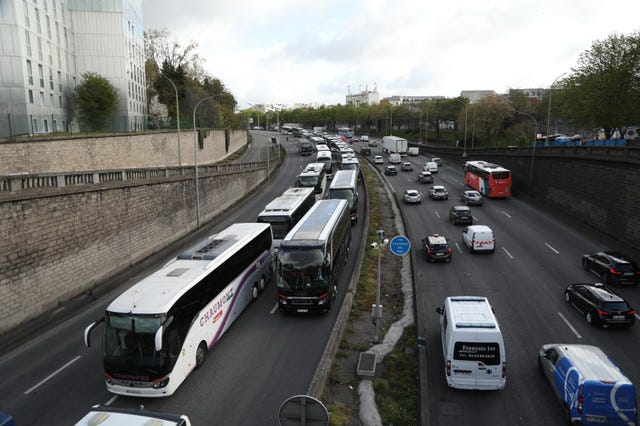
Twenty-five trucks and their drivers went to the A7 motorway, south of Lyon (Rhône), to block it. Measures taken to combat rising fuel prices have proven insufficient to eliminate discontent. Professionals in the transport sector want their voices heard. There will be no total blockade, but rather roadblocks with the distribution of leaflets to motorists, who are generally quite receptive.
The initiative comes from the union of small and medium-sized road transport companies. Owners claim to be suffering losses. “Filling up a truck or bus costs more than the service provided to the customer,” laments Jean-Christophe Gautheron of the European Road Hauliers Organisation.
And now, let’s recall the dozen or so farmers’ protests that have taken place in our country: how many of them have yielded concrete results? None. Why? Because the protesters believed the empty promises of politicians.
This closes this week’s installment of the WEEKLY ROUNDUP DISPATCH from FRANCE in collaboration with Anonymous Media Group and The Dirty Dozen Dispatch.
I am Jerry B. Marchant; you can subscribe to IS IT PROPAGANDA?®

 | A guest post by
|
 | A guest post by
|