

Nolan's Odyssey
by Vladimir Pozner
Dear readers and subscribers,
The text below is a strict translation of Vladimir Pozner's column from August 7, 2026. You can find the original text here. You can find the original text here.
Vladimir Pozner is not a new subject for me. I've written about him before, and I've had the chance to meet him in person in Moscow. An encounter that left a lasting impression of a man who has spent decades navigating, and shaping, the space between Soviet, Russian, and Western journalism. So when Pozner weighs in on a film—in this case, Christopher Nolan's “The Odyssey”—it’s worth reading closely, not for cinema criticism, but for what a lifelong journalist sees in a story about deception, consequence, and the fall of civilizations.

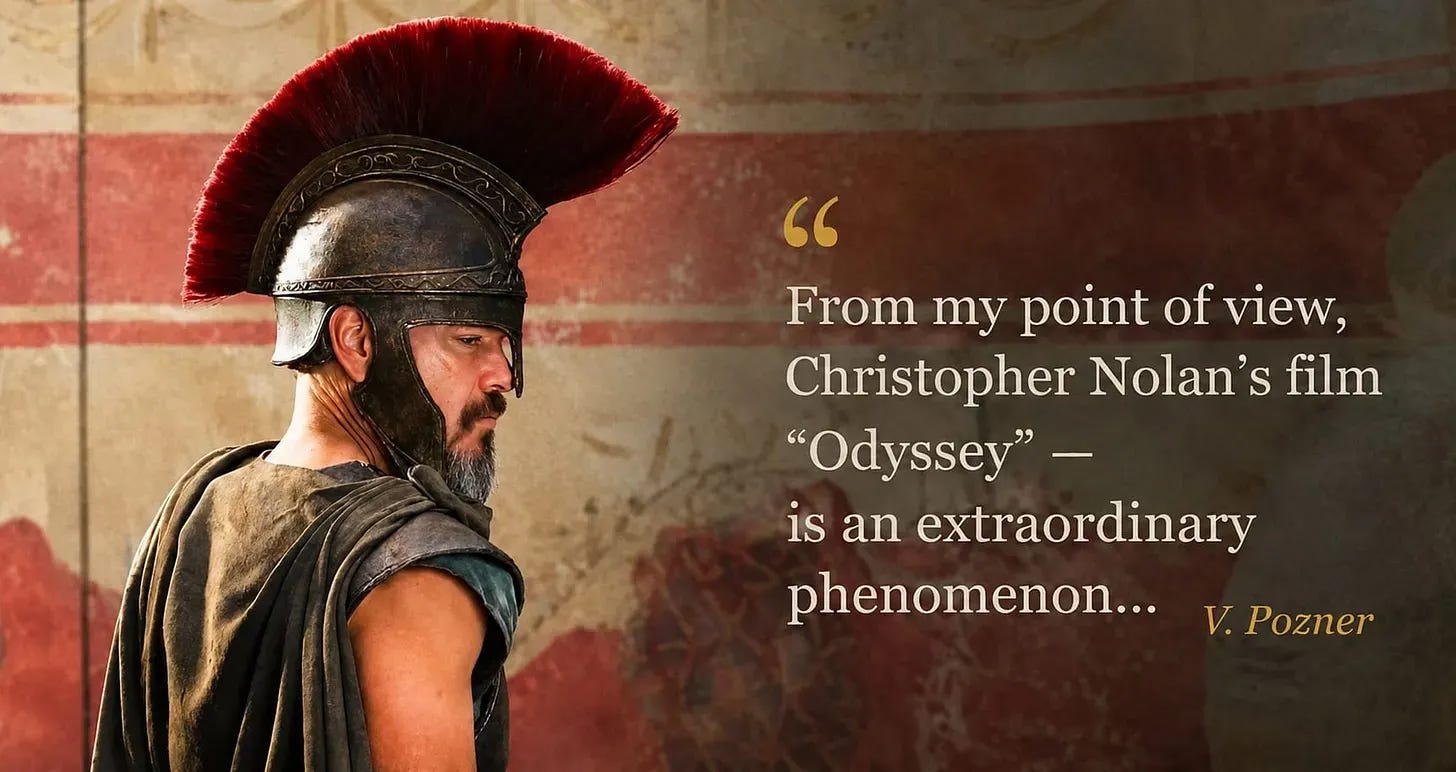
V. Pozner: “I recently watched Christopher Nolan’s film “The Odyssey,” and I wanted to share my impressions with you. But first, I want to stress something important: I’m not a film critic. I love cinema, but I’m not a professional and don’t claim any expertise in the art form. I can—and in this case want to—only offer my personal impressions of what I saw. I consider myself professionally versed in journalism and in nothing else, and I ask you to keep that in mind.
Let me start here: I think the overwhelming majority of viewers have never read the Odyssey—neither in Gnedich’s translation, which preserves Homer’s hexameter, nor in simpler retellings. And if I’m right about that, then I’m also right that most viewers didn’t understand what Nolan’s film is actually about.
What is the ancient Greek hero like? Fearless, merciless, always driven to win, and never troubled by compassion, doubt, or regret over what he’s done. That’s true of ALL ancient Greek heroes. It’s true of Odysseus too. Though he’s also cunning—there’s a word in English, “trickster,” that can mean both “deceiver” and “illusionist.” The horse Odysseus devised is both a deception and a trick, and he doesn’t regret for a moment that this deception-trick brought about the destruction of Troy. That’s Homer’s Odysseus. Nolan’s Odysseus is fundamentally different.
I’d go so far as to say the whole film is devoted to Odysseus’s suffering over that very deception, which led to the destruction of a civilization. All the adventure sequences—and there are many, beautifully done, in my view—circle back in one way or another to Odysseus’s reckoning with what he’s done. He understands that he bears responsibility for destroying a civilization, that he committed a deed that will be sung about but never written down, because those who inherit the ruins of this once-great civilization will be barbarians without writing, and a “dark age” will follow. There’s a direct line between Nolan’s Oppenheimer and his Odysseus. Both devised a deception trick, and both were horrified once they grasped what they’d unleashed.
I’ll set aside the question of who acted and how well, though I liked the whole cast. I especially won’t comment on remarks about the actors’ skin color, though I can’t resist telling you about a comment from a popular, respected person who told me, with a bit of mockery, that “in The Odyssey there are Black, yellow, and red people, but not a single Greek.” I very much wanted to tell him that even if every role had gone to an actual Greek, it wouldn’t have solved anything: today’s Greeks resemble the ancient Hellenes about as much as today’s Norwegians resemble the Vikings. I’d also have reminded him that there isn’t a single Dane in Kozintsev’s magnificent “Hamlet” and not a single Englishman in the Gesher Theater’s stunning production of “Richard III”—which floored me—where, on top of that, Richard is played by a woman.
To close: in my view, Christopher Nolan’s “The Odyssey” is an extraordinary achievement—one of the most powerful anti-war films I’ve ever seen and a stark warning about what awaits us if we don’t come to our senses: the destruction of civilization and the onset of a new dark age.
One last thing. This isn’t a debate. I’m not arguing with anyone or trying to convince anyone of anything. I simply wanted to share my thoughts—maybe someone will find them interesting.”

IS IT PROPAGANDA?® —Read. Decide. Question Everything.
Jerry as a Russian I do have a really great respect to you for being so knowledgeable about Russia and knowing such our prominent and important figures like Zhirinovsky and now Pozner whom most Westerners don't know. I have a feeling they don't know almost anyone except Putin and Medvedev, Navalny and Prigozhin, sigh.
Moreover most of their information about Russia is very ignorant and superficial and echoes either NATO or Kremlin propaganda. To read your objective and knowledgeable coverages on this background is like a breath air after sitting for too long in a stuffed room.
You're doing even better job of covering what's really going on in Russia and of things Russian than me because caught in cross-fire of Kremlin and NATO propagandists I just gave up...
But how had you acquired such an almost unique for a Westerner and profound and factual knowledge of Russia and all things Russian? Do you know Russian language or have Russian family members or have you lived in Russia? I'm genuinely curious.
And could we perhaps collaborate on Russia coverages at some point?
P. S. As for Odysseus review by Pozner itself, I disagree with his assessment but then it's a matter of opinion and I'm not a professional movie critic either.
Perhaps the most revealing question is not whether Nolan’s Odysseus is faithful to Homer, but why our age requires him to possess a conscience Homer did not give him in quite this form. The ancient hero’s cunning secures victory; the modern hero must live long enough to understand what victory destroyed. That is where the connection with Oppenheimer becomes compelling: intelligence ceases to be heroic when it discovers that its greatest achievement has made the world less habitable. Nolan is not merely retelling an ancient story; he is placing modern responsibility inside it.